stateDiagram-v2
    [*] --> Explorer
    Explorer --> Alchemist
    Alchemist --> Maverick
    Maverick --> Oracle
    Oracle --> Explorer: Next Level
I attended a 2-day workshop conducted by my company Toyota Connected India and TinyMagiq CoFounder Anandan Kumaran in Feb’26.
These are my learning notes to my future self and for all my readers.
I have updated the notes with my own research and experiences as well
Agenda
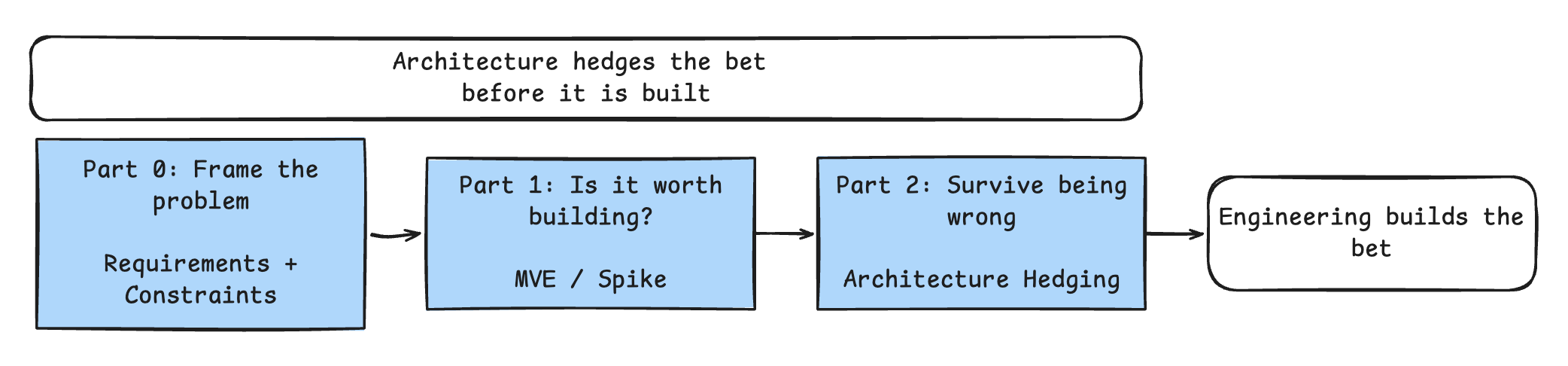
A walk through of the flow of this blog:
- Frame the problem first. - before designing or “architecting” anything.
- Ask if the bet is even worth placing - “Is this even worth building?”
- Survive being wrong - hedging with blue-green, canary, and feature flags.
- Balance five pillars without letting one win silently.
- Know where you stand as an architect. - Impact × Archetype matrix, Political Capital & HIPPO Effect
- Translate the technical bet into business language
- Win the last mile - communicate effectively so the decision lands.
- Closing thoughts.
0. Frame the Problem First
The “Problem Framing” Frontend to Architecture
This section - Business Requirements Understanding - sits before architecture decisions.
Understanding requirements is a pre-requisite before
- Part 1 - Sizing a bet (“Minimum Valuable Effort” - will be discussed later) or
- Part 2 - Hedge the bet taken
From Business Requirements to Architecture decisions
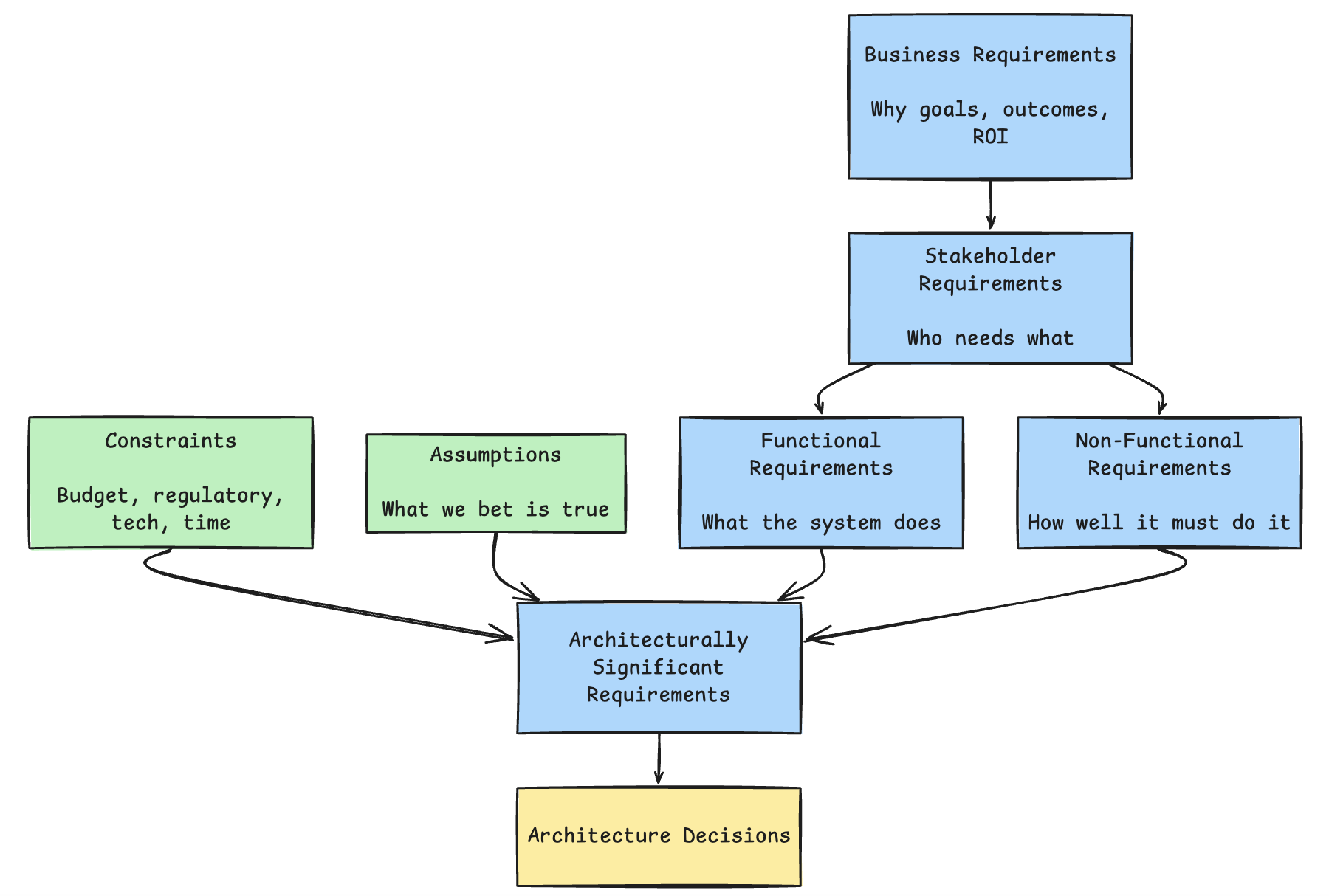
Before asking “is it worth building,” an architect asks “do I understand what is being asked?”.
Requirements are not flat. They form a hierarchy:
- Business Requirements — the why. The outcome the business is funding.
- Functional Requirements — the what. The behavior the system must exhibit.
- Non-Functional Requirements (Quality Attributes) — the how well. Latency, availability, security, scalability. Architecture is driven far more by NFRs than by features.
- Constraints — the non-negotiables. Budget, compliance, existing stack, deadline.
- Assumptions — the unstated bets. Documented, because every one of them can be wrong.
- The trap: treating every requirement as equally important.
- The skill is isolating the Architecturally Significant Requirements — the small subset that, if wrong, is expensive to reverse. Those, and only those, drive the hedging in Part 2.
Extracting Requirements: The Phantom Sketch Artist Technique
- Gregor Hohpe suggests sketching the requirements works better than asking for it.
- It makes people say “Oh, that’s wrong” - which is a good thing as a wrong sketch brings out the real requiremnts out of people faster
- refer this Hohpe podcast in YouTube
I. What is Software Architecture? A Set of Hedging Strategies
- The answer lies in the answer to two further drill down questions:
- Is the idea worth building?
- If built, how do we survive wrong decisions?
- v1: Architecture is the set of design decisions that must be made early in a project
- v2: Architecture is the way the highest level of components of a system are wired together.
- v3: *Architecture thinking helps in recognizing the most important elements that are likely to result in serious problems, should they not be controlled
- Sources: Martin Fowler’s Architecture Blog and Martin Fowler - What is Architecture
- v4: Architects are risk managers in disguise - Gregor Hohpe’s blog
- My personal Definition:
- Architecture is a set of “Hedging techniques/strategies” when building a software
Architectural Thinking = Hedging Strategies
A good quote from the Workshop by Anandan Kumaran: * Engineering places the bet. Architecture hedges the bet. * Engineering commits to a solution. Architecture assumes uncertainty and creates fallback paths.
Part 1 of Architecture Decisioning: Is the idea worth building?
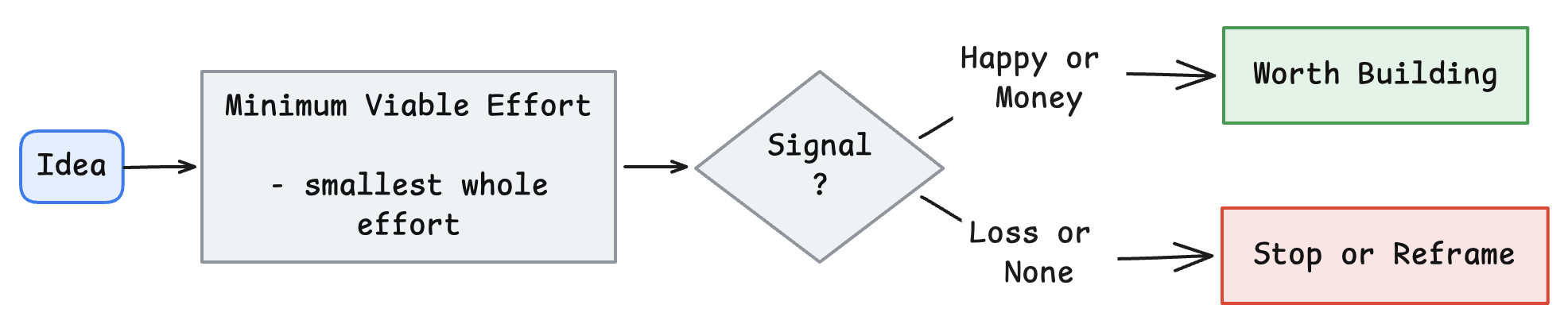
- A Minimum Viable Effort (MVE - a word play on MVP; MVE could be considered a subset of MVP) sits upstream of architecture. It reduces the size of the bet.
- MVE could be defined as: the absolute smallest action/step that can give a signal.
- In Agile Project Management world, it could be similar to a spike story
Part 2 of Architecture Decisioning: If we build it, how do we survive being wrong?
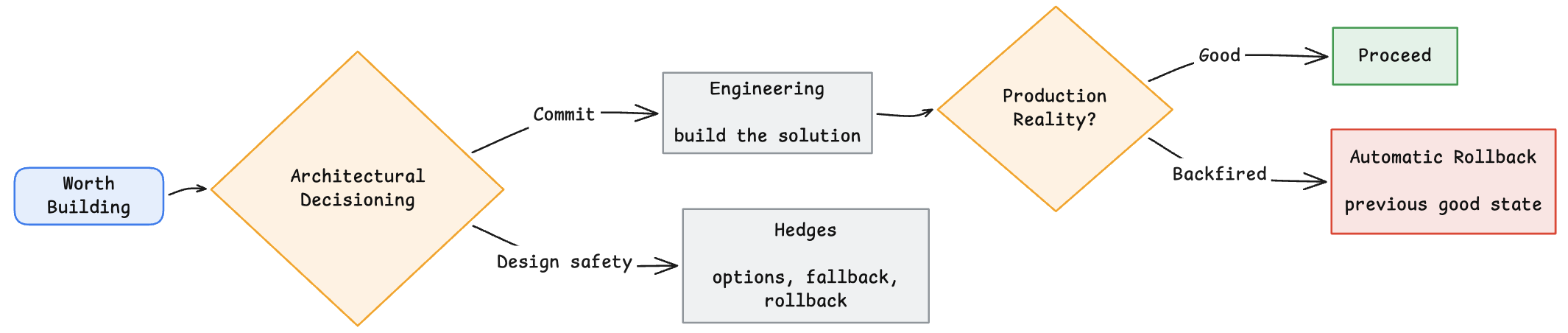
- Architecture then reduces the blast radius of the bet.
- Engineering executes the bet once it is worth taking.
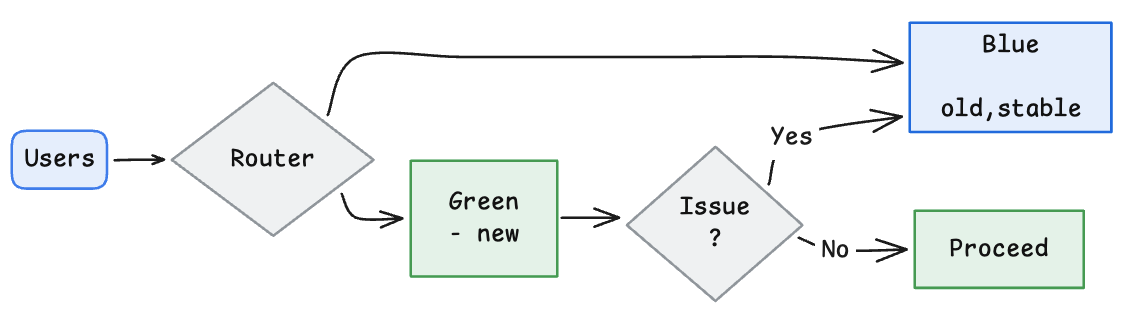
Surviving Wrong Decision: (1) Blue-Green Deployment
Blue-green deployment is architectural hedging in its most practical form. Martin Fowler’s original writeup remains the cleanest explanation.
- You deploy a new green version.
- You keep the old blue version alive.
- If reality disagrees with your assumptions, you switch traffic rather than rebuilding under pressure.
Surviving Wrong Decision: (2) Canary Releases & (3) Feature Flags
Not All Risk is the Same Risk
Matching the hedging strategy to the risk: Replicas Handle Failure, Blue-Green Handles Regret
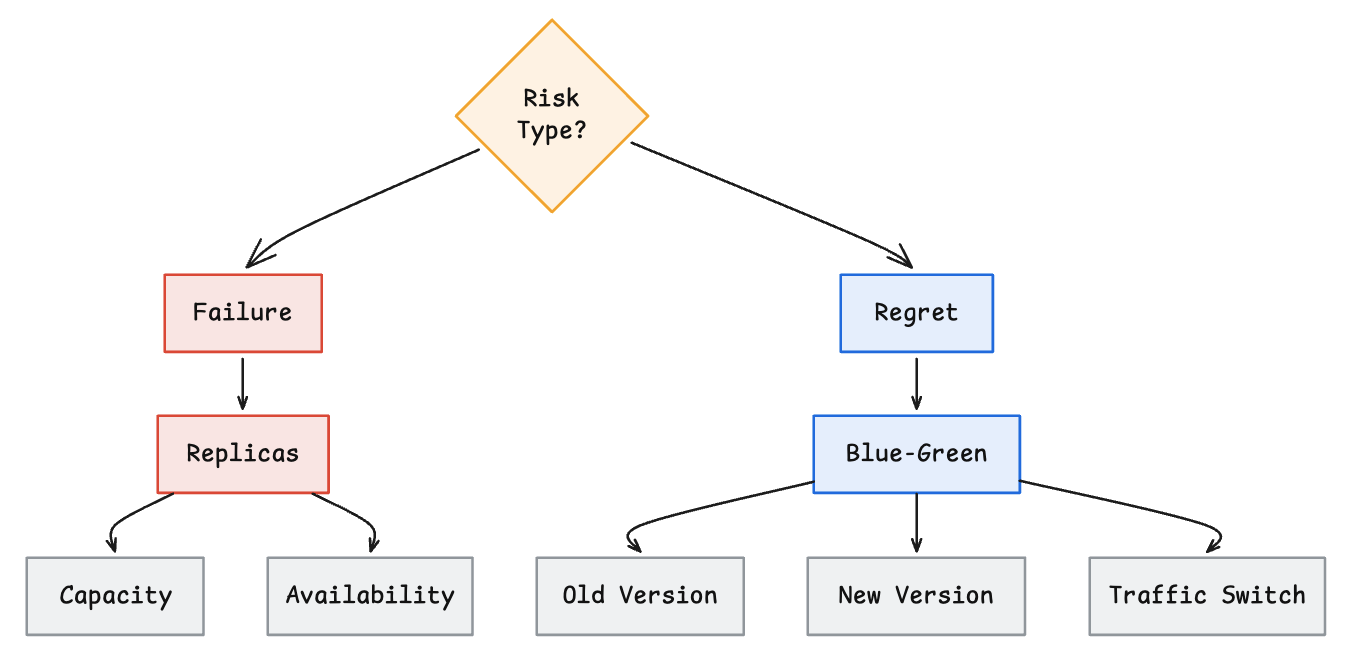
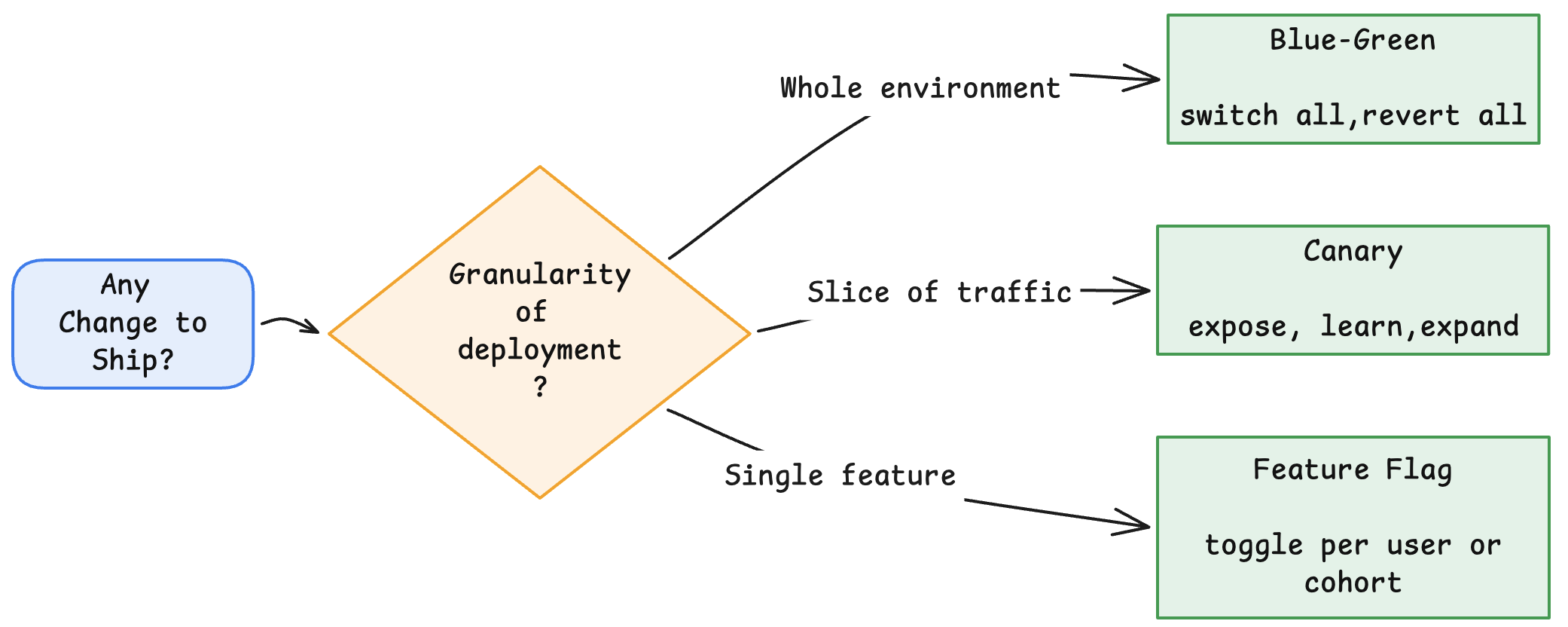
Blue-green is a coarse hedge. We flip all traffic from one full environment to another.
Sometimes we want a smaller, more controlled bet. That is where canary releases and feature flags come in.
In Feature Flags, for certain users, some features are turned ON for testing
In Canary Release, only a certain small section of users are tested first before going fully into new version
Sources: - FeatureFlag - CanaryRelease
II. The Five-Pillar Lens of Product / Architecture Decisions
Architecture decisions should be evaluated through five lenses:
- Quality
- Design
- Business
- Engineering
- Human Dynamics
A highly opinionated view (in a way this prioritizes the pillars)
- Business Strategy = Entry Fee before building a product
- Design + Engineering = The compulsory hardwork while building the product
- Human Dynamics = The differentiator

As Architects, we must think negative:
* No pillar is allowed to “win” silently. Trade-offs across all five must be explicit. * Optimizing one pillar in isolation creates silent debt in another
What Each Pillar Is and Isn’t
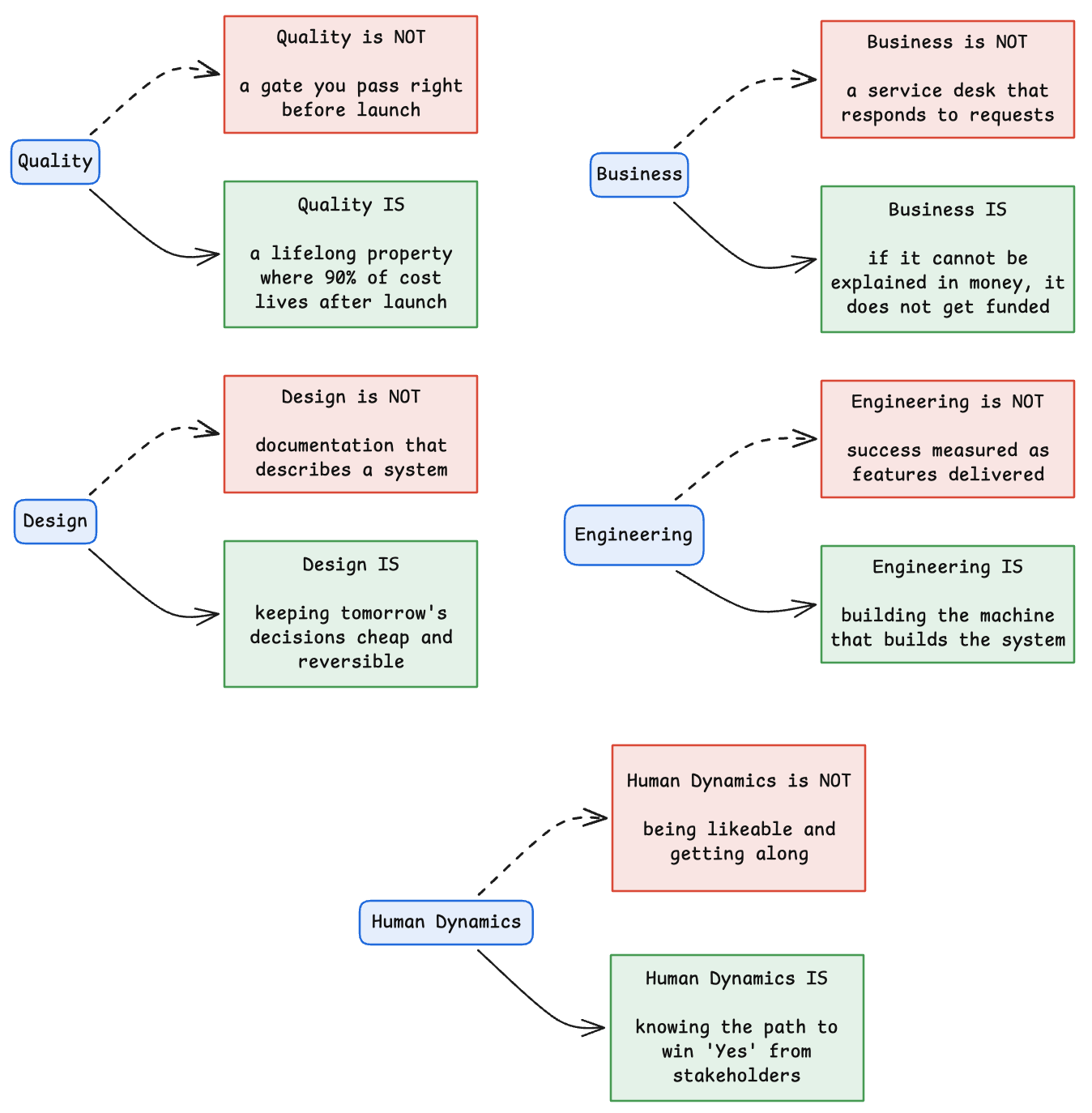
The Quality Pillar is where NFRs live and get measured
A pillar you cannot measure is a slogan. Quality is not a launch gate. It is the home of NFRs (reliability, recovery, latency, security) that must be verified continuously, not declared once.
- “99.9% uptime” is a wish. A fitness function (an automated check on an architectural characteristic) makes it a property.
- NFRs are leading indicators. The outcomes they protect (churn, revenue, trust) are lagging. Fix the leading ones first.
- Every NFR needs an owner, a number, and a test. Without them, it becomes silent debt elsewhere.
Constraints & Assumptions as First-Class Citizens
Trade-offs happen inside a box. Constraints are the walls. Assumptions hold them up. Write both down before building, not mid-build.
- Constraints are non-negotiables: budget, compliance, existing stack, deadline, team topology. You cannot “choose” what a constraint already decided.
- Assumptions are unstated bets: expected load, data volumes, third-party SLAs, “the team knows Kubernetes.” Each can be wrong. Each is a hedging candidate for Part 2.
- Make them explicit. An unwritten constraint becomes a production incident. An unwritten assumption becomes a post-mortem line item.
III. Where Do You Stand as an Architect?
The workshop describes growth across two dimensions.
- Impact (Self, Team, Org, Industry)
- Archetype (Explorer, Alchemist, Maverick, Oracle)
Leadership Matrix: 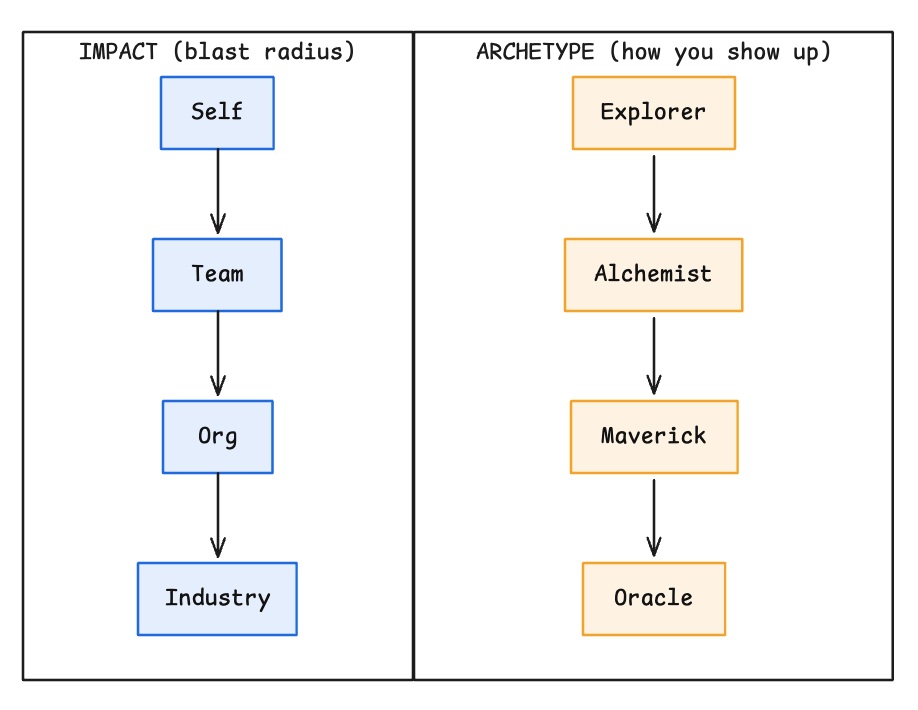
The most useful insight is the growth model.
Every time impact expands beyond a threshold, an Orcale resets to an Explorer.
Growth is not becoming a bigger expert. Growth is becoming a beginner in a larger arena.
Informal Power: Political Capital and the HIPPO effect
- The workshop makes a strong distinction between formal power and informal power.
- Formal power comes from a title. Informal power comes from trust, tenure, and perceived seniority.
What formal title offers: The HIPPO effect (Highest Paid Person’s Opinion) is a well-known name for what happens when power overrides evidence.
Why architects should care:
- Data does not automatically win. Room dynamics do.
- A quiet, tenured engineer (“informal power”) can veto a decision without saying no.
- A senior leader unfamiliar with the domain can steer a design purely by leaning in.
Architects who track only formal decision-makers miss the actual decision surface. Related reading: Bernard Marr on the HIPPO effect and data-driven decisions.
- Note:
- Personally, I have gained respect and received brickbats countering the HIPPO effect - either by consciously or unintentionally voicing the cons of decisions by people in power
- It is important to read the room before deciding to counter the HIPPO. This is mentioned as “leveraging the political capital” in Hohpe podcast in YouTube.
- A quip from the video: “Save capital for the decisions that actually move the needle”
IV. Translating Technical Bets into Business Language
How do I connect code to the boardroom?
- Don’t pitch “Kubernetes”; pitch “20% cost reduction.”
- Same work, different framing — audience determines vocabulary.
- If a pitch doesn’t hit one or more the holy trinity: Risk reduction, Cost optimization, or Growth in 30 seconds, it loses the audience
Architects frequently lose stakeholder support because they stop at technical reasoning. The workshop repeatedly emphasizes translating technical decisions to business funded outcomes.

A few of the tools that help in converting a decision to a durable outcome:
Four stages turn a technical decision into a funded outcome.
Stage 1 — Decide and Record (ADRs)
How do I prevent “why did we do this” debates?
- A 20-minute record capturing what we decided, why, and what we traded away.
- “The palest ink beats the best memory.”
Stage 2 — Price the Bet (ROI, TCO, NPV)
What is this decision worth in money?
ROI (Return on Investment) — gain over cost, best for short horizons. - Formula: (Gain − Cost) / Cost. - Weakness: it hides timing. A slow 40% can lose to a fast 20%. [XIRR](https://support.zerodha.com/categorye/portfolio/console-holdings/articles/xirr-and-cagr-for-equity fixes the timing blindspot.
TCO (Total Cost of Ownership) — the full lifetime cost. - Licensing, infra, ops, support, migration, retirement. - Best when something looks cheap upfront but expensive later.
NPV (Net Present Value) — future cash flow in today’s money. - Respects time: a dollar in three years is worth less than a dollar today. - Best for long-lived investments.
Stage 3 — Prioritize the Bets (Run/Grow/Transform, RICE)
Given limited budget, which bets win?
Run / Grow / Transform — the portfolio split. - Roughly 60% Run (lights on), 20% Grow (features), 20% Transform (trend-breaking bets). - Don’t let “Run” eat the whole budget silently.
RICE — scores competing initiatives.
(Reach x Impact x Confidence)
  -------------------------
Effort- Best for comparing initiatives of different sizes and audiences.
- Weakness: strong for incremental work, weak for novel bets where reach is unknowable.
Stage 4 — Pressure-Test, then Pitch
Is the argument ready, and how do I deliver it?
The “So What?” test — ask “so what?” until you hit a dollar sign or a human consequence. If you can’t reach one, the proposal isn’t ready.
The 5-stage executive pitch — once the passes So What test is passed: Burning Problem → Why Now → Proposed Solution → Trade-off Map → The Ask. - The Ask = the specific decision you want leadership to make. - Skipping stages weakens the pitch proportionally.
V. The Architect’s Last Mile: Communicating the Decision
Once you have the right decision, how do you make it land?

U‑PSA Storytelling Framework — How do I make a story stick?
- U (Unusual) → Problem → Solution → Achievement.
- Without U, PSA is intellectually correct but emotionally inert; U is the ignition.
Cumulative Unusual — How do I create an Aha moment from ordinary facts?
- 50 pushups/day is boring; 200,000 pushups in 10 years is unforgettable.
- Temporal or scale compression transforms the ordinary into the unusual.
Clarity more important than being Complete — What kills my message?
- Completeness over clarity is a mistake: Clarity is a gift to the receiver; completeness is comfort for the sender.
Ethos / Logos / Pathos — What makes a pitch persuasive?
- Ethos (credibility), Logos (logic), Pathos (emotional stakes).
- All three must work together; logic alone doesn’t move decisions.
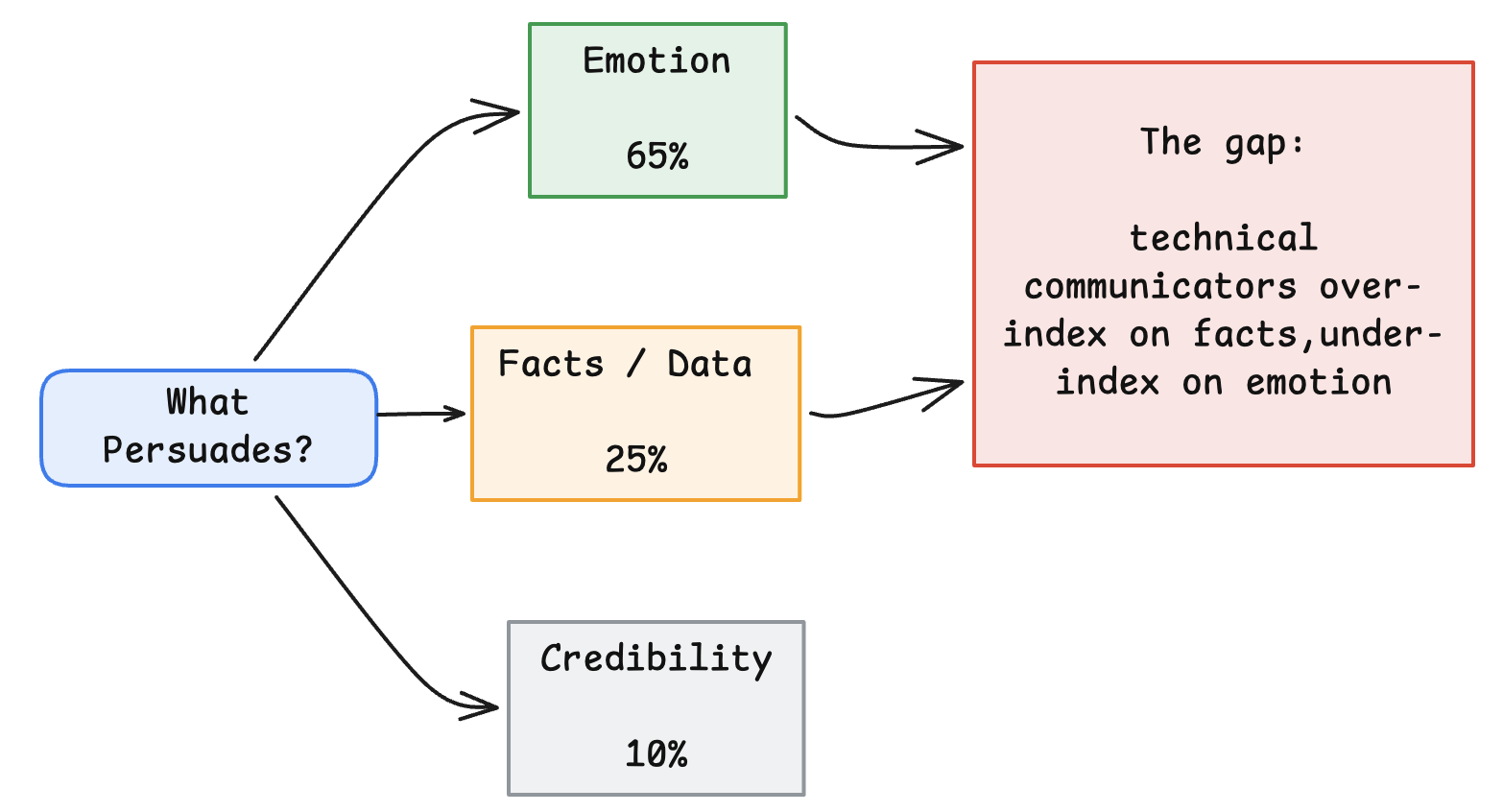
TED Talk Formula — What ratio drives persuasion?
- Facts/Data: 25%, Credibility: 10%, Emotion: 65%.
- Most technical communicators over‑index on facts and under‑index on emotion.
Power of Metaphors — How do I make technical concepts land?
- How much longer iPad lasts? - “10 hours of video watching” >> “4200 mAh battery.”
- Metaphors translate abstractions into the brain’s native format — lived experience.
VI. Closing Thoughts
The journey from engineer to architect is not about drawing larger diagrams. It is about becoming better at managing uncertainty/risk
- Gregor Hohpe’s quote: “Architects are just risk managers in disguise”.
The workshop material repeatedly returns to the same idea:
- Test the idea before committing.
- Make trade-offs explicit.
- Preserve options.
- Design for survivable failure.
- Translate decisions into outcomes.
Most often we toggle between code-level (“Engineering” mindset) and strategy-level (“Architect” mindset). How effectively we do this switch in thinking determines how successful we can become.
A final takeaway:
Engineering makes progress possible. Architecture makes progress survivable.
VII. Amazing Sources
- Martin Fowler’s Blog: martinfowler.com
- Gregor Hohpe’s Blog: architectelevator.com
- TinyMagiq CoFounder Anandan Kumaran’s teachings